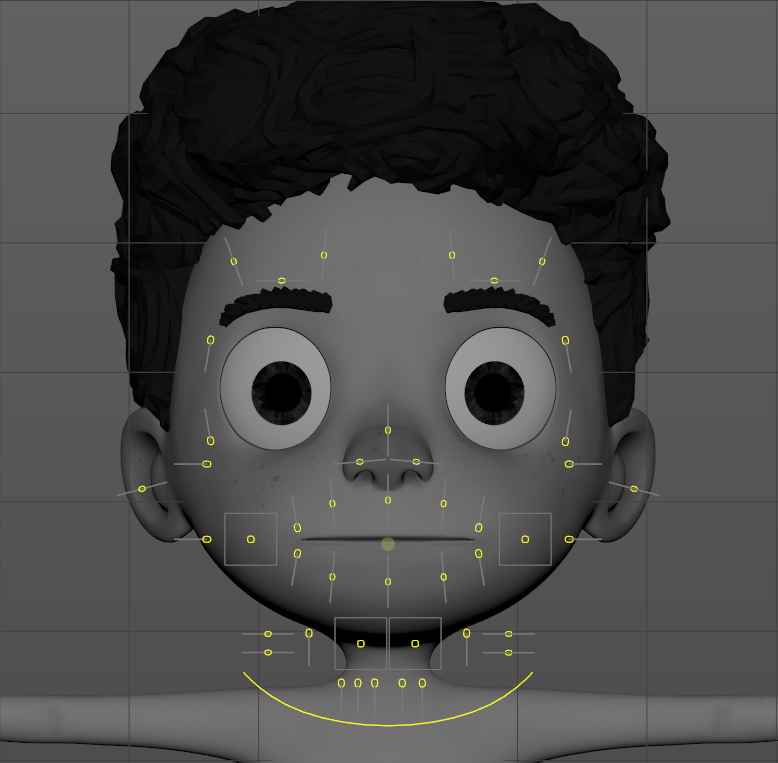
A bit of look dev for a film that I'm working on. I had so many film projects that I lost interest in and died out... so I don't want to say any more about the film for now, for fear that I will jinx it :] But when I will have some stuff to show... I will.
All rendered with Maya's viewport 2.0 and then color corrected in comp. Click above pic for larger image.
If you wanna see the saga of this picture, click below too.
There are 2 tests, the first one is using one shader for the whole scene. First pic is what I rendered in 3D, and the others are different comps. The one-shader aproach (or using 2-3 shaders, stuff that I tried before) means that it's easy to... well... shade the scene, and the whole thing looks more homogenous. Also, there are very few lights: a Key, 2 Fills, and a bit of Rim lighting. Plus the SSAO. And a second test with a bunch of shaders. The initial 3D scene looks quite awful, all over the place, but then with some color correction I managed to get a result that's much more interesting than the one-shader aproach. The homogeneity I lost by using lots of shaders (and which I tried and failed to fix with lighting... because this is, after all, a very rough real time renderer) is solved, quite well I think, with color correction.
Oh, and btw, if you clicked through the pics already you probably noticed a few painterly tests and combinations of 'photo' and 'paint'. I think the combinations are not bad... a bit of painterly stuff to mess thing up and homogenize even further, and then bring back the detail by dialing in 50% normal image. Still, I don't think I will use the painterly approach on the film.
The version I liked best is, of course, the one I posted up above, at the very beginning.
A small but very useful piece of code. I've been looking for a while for a script that moves vertices along normals, in Maya, for an entire object, like the Peak operator does in Houdini. For inflating or, especially, deflating geometry (like if you mesh some volumes and the result is a bit too round and blobby ). It's not a huge thing... you can even do it with polyextrude and then delete junk, but it's just not the same thing really... since polyextrude changes the topology. So anyway, since this doesn't come off the shelf with Maya, as far as I know, and I also couldn't find any script anywhere... here is the code that you can add to a shelf button. In its simplest form, no interface. Just select and object and click the button/run the code.
string $tempSelection[] = `ls -sl`; int $vertNumber[] = `polyEvaluate -v $tempSelection[0]`; for($n = 0; $n < $vertNumber[0]; $n++) { select $tempSelection.vtx[$n]; //replace the -0.01 value below to increase or decrease the effect. //set it to a positive value to inflate rather than deflate. moveVertexAlongDirection -n -0.01 ; } select $tempSelection;
OK.. but I should mention it has a small problem, it's kind of slow, because it iterates over each vertex, so it repeats the command as many times as there are vertices... it's fast on a small mesh, but on a large poly mesh it can take a lot of time. A polyextrude is much much faster.
I've been working on a cute lil' project for Ubisoft for this past year. It started as an internal Ubisoft coding competition, in its first phase. For that I drew, among other things, a bunch of stylized Ubisoft characters, which I can't show to anyone anywhere... ever. :D So anyway, now, in its second phase, it's got a name and a website: Brains for Games. If you want to see the game in action, download it here, extract it, and start \Package\Bin\Matchmaker.exeAnd no, you can't play it, it's for bots only... :( But you can build your own maps with the MapEditor found in the same location. OK, one superimportant thing to do, after you start the game, click on the magic Color to Black and White button on the upper right corner! :D Thanks! M'kay, so I drew basically everything, from character design to environment, to icons for the interface. And I made some very simple silly animations for all the characters as well.
What's the deal for coders: they have to code one AI character, a bot, that will fight against other bots, and the smartest AI wins.
So the work I've done for the 2D game.
1. The characters:
Blumchen Fluffy Gagarin Mr. Bogey Robosept Von Karajan Cpt. Whitebeard Woodsman Bob 2. The environment.
And this is how the game looks. I intended it to be black and white, like a cartoon, but... the monstrous programmers insisted that they can't see the difference between characters well enough without colors. So there is a beautiful version in BW, and a horrifying colored version........ The BW version, click on it to go larger: I don't even want to show you the color version... I hate it... OK, I'll show it to you :P And the way the game ends, if no one wins... The art department also insisted they want to model some of the characters for a 3D version, for promotional purposes. Two of them I then rigged and my colleagues animated a short, for fun (and promo, possibly) which is not yet rendered, but when it will be ready I will post it. For now, here are some reinterpretations of my characters done by my colleague, Andrian Luchian. I like Robosept (the "Bomberbot") the most, he really changed the design quite a bit, and gave it interesting functionality. The 3D was based on them, because my drawings were a bit too... 2D-ish I guess. Andrian's versions have volume and the details are clearer. And the 3D models. Click for larger image. The message on Gagarin's chest is written by the modeler, probably directed... at the people who forced him model this silly character... :D OK, even more likely... towards me, because if it wasn't for me drawing this character in the first place... And lastly... a bit of video: Ubisoft's presentation posted by them on You Tube (all featuring the color version, ugh, it hurts :D ), and a link to more stuff.
M'kay, I bought an cool new mic recently, a Samson C01U. Very good for cheap people like me who can't afford to record in a professional studio, or to build something like that. So what would Virgil do with this new mic... what better, more artistic and more glorious.. than trying to experiment with cool pseudo-nordic languages by improvising around an existing text, previously translated with Google-translate, from English... into various languages... and trying to make it sound sort of like a...germanic-nordic-viking-fantasy kind of thing. :) It's fun, like all improvising.
I used this text from the good doctor... Seuss:
Oh, say can you say? Said a book reading parrot named Hooey, "The words in this book are all phooey."
See if you can recognize the poem... (PS - if you think all this is mental, you are probably right. And you are on the wrong side of the internet... :D )
In pseudo-norwegian, 3 versions pseudo-sweedish, pseudo- welsh (keep in mind that this all is bs, is not supposed to sound anything like welsh, or thai, or polish, etc... but like a pseudo-nordic-pseudo-germanic thing. I don't even know how welsh sounds like :/ )
pseudo-maltese
pseudo-irish
pseudo-finnish, 2 versions
pseudo-estonian
pseudo-dutch, 2 versions (pretty funny)
pseudo-danish
pseudo-czech
pseudo-croatian
pseudo-basque
pseudo-albanian
pseudo-afrikaans
pseudo-icelandic
pseudo-latvian
pseudo-lithuanian
pseudo-polish (this one I find expecially funny)
pseudo-romanian (hard to do, it's easier to improvise/mess up a language when you don't understand a word of that language)
pseudo-tamil
pseudo-thai
pseudo-german (boring... too obvious. I also messed up the beginning, bleah)
pseudo-english (again, hard to improvise... since I know the language)
and pseudo-nothing... or generic. should be called pseudo-virgil-germanic, has to be very rough, with lots of grrrrund grrrong grrracht garng gr rrgg ggg rrgggg (I wasn't really reading a text in this case, but more like... playing with the sonority of the main words and improvising in beautiful virgilian style...) In the end the versions I liked the most are Norwegian and Icelandic. Norwegian is cleaner and easier to read and has the beautiful ø character, Icelandic has more outlandish characters such as Ó þ ú ð á... and looks more lush and luxuriant, which provides richer inspiration when improvising. :]
So I did a test reading in pseudo-Icelandic the beginning of the Hobbit. Here's the English text:
In a hole in the ground there lived a hobbit. Not a nasty, dirty, wet hole, filled with the ends of worms and an oozy smell, nor yet a dry, bare, sandy hole with nothing in it to sit down on or to eat: it was a hobbit-hole, and that means comfort. It had a perfectly round door like a porthole, painted green, with a shiny yellow brass knob in the exact middle. The door opened on to a tube-shaped hall like a tunnel: a very comfortable tunnel without smoke, with panelled walls, and floors tiled and carpeted, provided with polished chairs, and lots and lots of pegs for hats and coatsthe hobbit was fond of visitors. The tunnel wound on and on, going fairly but not quite straight into the side of the hillThe Hill, as all the people for many miles round called itand many little round doors opened out of it, first on one side and then on another. No going upstairs for the hobbit: bedrooms, bathrooms, cellars, pantries (lots of these), wardrobes (he had whole rooms devoted to clothes), kitchens, dining-rooms, all were on the same floor, and indeed on the same passage. The best rooms were all on the left-hand side (going in), for these were the only ones to have windows, deep-set round windows looking over his garden and meadows beyond, sloping down to the river. This hobbit was a very well-to-do hobbit, and his name was Baggins.
Beautifully translated into Icelandic by Google:
Í holu í jörðinni bjó Hobbitinn. Ekki viðbjóðslegur, óhrein, blautt gat, fyllt með endimarka orma og oozy lykt, né enn þurrt, ber, Sandy gat meðengu í það að setjast niður á eða til að borða, það var Hobbitinn holu,og að þýðir þægindi. Það var fullkomlega umferð dyrnar eins porthole,máluð grænn, með skínandi gulum kopar húnn á nákvæmlega miðju.Hurðin opnuð í rör-laga stofu eins og göng: a mjög þægilegt göng án þess að reykja, með þiljuðum veggi og gólf flísum og teppalagt, endameð fáður stólum og fullt og fullt af hæla til hatta og coatsthe Hobbitinnvar hrifinn af gestir. Göngin sár á og á, að fara nokkuð en ekki alvegbeint inn í hlið hillThe Hill, sem allir menn til margra kílómetra umferðkallaði itand margir litlir hurðir umferð opna út af því, fyrst á annarri hliðinni og síðan á annað. Engin fara uppi fyrir Hobbitinn:svefnherbergi, baðherbergi, Cellars og pantries (hellingur af þessum)og fataskápum (hann átti allt herbergi sem varið er til föt), í eldhúsi, borðstofu-herbergi, öll voru á sömu hæð, og raunar á sömu leið . Bestaherbergi voru allir á vinstri-hönd hlið (að fara í), fyrir þetta voru einir aðhafa glugga, djúp-setja umferð gluggakista leita yfir garðinn hans ogMeadows utan, fallandi niður að ánni. Þetta Hobbitinn var mjög vel tilað gera Hobbitinn, og nafn hans var Baggins.
And messed up by me (2 min of pseudo-Icelandic. and please excuse the change in pitch, I have an obsession with messing up with voice pitch and speed... anyway, this is the version that turned out the most fluid and interesting): But I didn't stop here, I found this wonderful website that allows you to reverse and scramble text, and do sooooo many more wicked things with text and numbers: check out the Reverse-Text-Generator. Reverse examples: In a hole in the ground there lived a hobbit. .hobbit a lived there ground the in hole a In .tibboh a devil ereht dnuorg eht ni eloh a nI Ni a eloh ni eht dnuorg ereht devil a tibboh. Scramble examples: In a hoel ni the ugrond heret liedv a htbobi. In a ohel in hte odrgnu erhet edliv a bhitbo. I like the scrambled (randomized) text best, because it sort of keeps the logic of the phrase and the overall sonority of the original text. Basically, while improvising my pseudo-nordic, I could end up with similar results for the 2 phrases below: Í holu í jörðinni bjó Hobbitinn. (Icelandic) Í lhuo í jörðinni bjó Nbhoibitn. (Scrambled Icelandic) Some words might be identical even, but there is, hopefully, a smaller chance that the language will sound familiar to an Icelandic native... (well, in fact, to an Icelander, if they manage to recognize some of the words, all this could still sound like some sort of Icelandic spoken by a retard :D) The last 2 recordings are the full Hobbit text spoken in reversed-pseudo-Icelandic (not so good... if I may say so...), and scrambled-pseudo-Icelandic (almost as good as the original pseudo-Icelandic... still, gotta work on it :D and I probably was tired of so much hobbitin...). Well, the conclusion is that this scrambled-pseudo-Icelandic might... work... as a pseudo-nordic language for my pseudo-nordic characters. Yeeey!
And the very very last conclusion: Høøøøøbbbbiiiiiitttttttiiiiiiiiiiiiinnnnnnn!! (Image used without permission, illegally, yes, precious, if I had the permission I'd probably be too awesome... and I'd have superpowers...)
VIEW strikes again this year and it's worth checking out! Here are some links and details. www.viewfest.it http://viewconference.it VIEW Conference is the premiere international event in Italy, on Computer Graphics, Interactive Techniques, Digital Cinema, 3D Animation, Gaming and VFX. 16 – 19 Oct | VIEW Conference, 13th International Computer Graphics Conference 19 – 21 Oct | VIEWFest, Digital Movie Festival VIEW Social Contest, Animated Short Competition with 3D animation and VFX that deal with social and current issues. Deadline to submit is June 30th 2012 VIEW Award 2012, World Wide Short Competition Using 3D Animation and VFX. Deadline for submissions: 15 Sept 2012 ITALIANMIX 2012 – Contest of short movies realized by Italian or Foreign film-makers, having as their topic Italy or Italian subjects. The selected works will be included in the screening program of the VIEWFest in Turin and will be part of the ‘best of ITALIANMIX DVD’. Deadline for submissions: 15 Sept 2012 Call for workshops Deadline July 31st. Call for papers Deadline August 31st.
pfx geometry - 3d-coat - back to maya - having fun with some shading... there you go, paperscapes
Should I post this here... hmmm... maybe it'll help someone, someday, so why not? Who feels bothered by this wise-advice-from-young[ish]-people-who-don't-know-s***-about-s*** kind of thing, well then... please ignore this and just... move along, move along :} I got a few emails lately from people asking for advice (ooo, nice, people asking ME?.. for advice?... OK, it doesn't happen often, more like once every 20 years or so...), about how to get started with animation, what software to chose, stuff like that. And yesterday I got this email that I replied in more detail to, and thought I could post it on my blog as well. Beginners are always full of questions and there can never be enough answering on the whole internet... for their insatiable apetite for answers :D Also, a good thing to know, I guess, is that my answers are not so... entirely original, but I believe they go along a similar line with the opinions of many animators who wrote about animation. I followed their advice, still follow it (I think... :/ ), and pass it on for others to read as well :] So... here are the questions I got in this recent email [from a person with a very cryptic name... who I didn't ask for permission, so shall remain nameless for now]: I wanted to ask you where did you learn all of these? What can I do in order to simplify the animation process? What software do you recommend to use for 2D? Just Flash? Toon boom? And for 3D why is Maya better than 3D Max? What books do you recommend me? What are good steps to create characters personalities? I was a complete beginner too not so long ago and I understand the awe and confusion in front of something that seems so complex. I think that you have to take things one at a time, start small and simple, and learn as much as you can from as many sources as you can find, that's how I learned at least :) Definitely start with a solid foundation in body mechanics before you go into acting. Look at what the Animation Mentor students do, I think it's a good example. Keep an open mind and open attitude towards learning. And sources.... there are many. I started by browsing forums, like cgtalk, and reading what people had to say, finding out about the major animation books and websites, etc. Here are some books to read, and then to study... Richard Williams - The Animator's Survival KitJohn Halas, Harold Whitaker - Timing for AnimationPreston Blair - Cartoon AnimationEric Goldberg - Character Animation Crash CourseWayne Gilbert - Simplified Drawing for Planning AnimationEd Hooks - Acting for AnimatorsFrank Thomas, Ollie Johnston - The Illusion of Life: Disney AnimationWalt Stanchfield - Drawn to Life: 20 Golden Years of Disney Master Classes: Volume 1&2: The Walt Stanchfield LecturesNow, there are lots more books out there, but these here I found to be the best, most inspirational and most helpful, written by pros, by people who really know animation. Another thing is that... unless you're lucky enough to get into a really good animation school, like Call Arts or Animation Mentor, Sheridan, Ringling, Gobelins... there are very few in the world, probably, you won't get a mentor that has real first hand experience with animation and who is also a very skilled animator, you'll learn from people who teach, and who don't animate. So... that's not good :) You'd get to learn some software, not how to animate. I saw this happening at the school where I studied and a lot of people write about this, so it's not just my opinion. OK, so you can start to learn on your own, if you can't afford a good mentor, but a mentor is enormously helpful for an animator. You can learn from books, internet, forums, and you should definitely get feedback from people (on internet forums for instance, or from friends. Although don't get too upset when they don't know what they're saying :) A lot of time people give you feedback on the things they see, not on what you'd expect. Take notes when they talk, don't defend your work, let them talk, and use that information if it's helpful, or feel free to discard it). And then you build your first demo reel (there is a TON of information out there on do-s and don't-s for an animation demo reel). And send it to studios, no matter if they are or are not hiring. Junior jobs are many times not advertised. And use job-listing websites of course, to look for openings (although I must admit I never did), there is a much better chance of getting hired if they actually... need people. So good timing is important (if you send the letter 2 weeks after they're full and done hiring... oops, too late). And then you get a first job, if you can, and if you can't... try again, and again, and get better and try again, and you'll succeed... hopefully (there still is a need for animators in today's fast changing world but there's no way to really know what'll happen in 10 or 20 years... The fact is that the Animation Industry is growing and schools produce more and more animators per minute...). So, after you get your first job, that's where you really start learning, and hopefully find experienced animators who are also kind enough to give you advice, and let you look at their work and the way they work. I think it's enormously helpful for an animator to look at another animator working. Which is why I really recommend getting to see any Jason Ryan training videos. That was for me an eye opener and I think it's some of the best animation training you can find anywhere. A few awesome animation websites btw (I'm sure you looked at the links on my website, and please do the same with any animator/animation website's links, they usually link to very cool blogs and other animation resources. I use Google Reader btw to quickly read or skim through my hundreds of blogs that I follow... when I find some time :P ): http://splinedoctors.com/http://animationtipsandtricks.com/http://carlosbaena.com/http://animationmeat.com/Last thing, about that Maya vs Max issue... it doesn't matter. In fact, if you want to learn animation, I'd start with a 2D animation software and draw 100001 bouncing balls of all kinds. That's the basis for understanding timing and spacing, right there, and it's very easy and fast to draw/animate a circle in a 2D software, and you also get to better understand what you're doing, because there is no automatic inbetweening from the computer. You are the inbetweener. Some good 2D animation software are Flipbook, PAP, TVPaint, Toonboom, Flash... and any 2D software is more or less fast and easy to learn. And if you really want a bit of advice on 3D apps, I'd say that, in my personal opinion, Max might be easier to learn and use, so is XSI and Lightwave, Maya is maybe a bit tougher to learn, and Houdini is probably the toughest. Choose one and focus on learning that one, not 2 or more, for the first year at least. If you need a job at a studio where they use XSI, if you already are comfortable with, say... Maya, it shouldn't take you long to learn the basics of XSI. And basics is all an animator needs in order to animate in a 3D software, honestly, although some people might disagree. You get to animate a rig, not create the rig. So you have to understand that rig's interface and controls, and how to navigate and use the 3D app at a basic level. But I should also mention that... many animators out there learn/use Maya, and one of the reasons, I presume, is... because there are tons of good free rigs for Maya out there, to help you learn animation and animate on, which you probably won't find for any other app. Back to animation, I'd say... it may take about 2-3 years to learn character animation up to a decent level, if you invest a lot of passion and time into it, and then, according to Shawn Kelly, you should be an experienced animator in about 10 years. But it totally depends on your efforts, your talent of course (there are people who are born actors... and people who couldn't convince a dog to bark), and your environment/the place where you work (meaning if your focus/your company's focus is on quality animation or not). And then, you keep learning and discovering for 100 more years, after which you can take a break and start learning something new. Yep, takes time, effort, involvement... but it's a lot of fun! Last but not least, about personality... that's probably the hardest thing in animation. It's the 'character' in 'character animation' that's the bee's knees... and it's a long way up to reach the bee's knees :} Learn the basics first :} Oh, and I almost forgot about the second question here, how do you simplify the animation process... short answer: do you? Haha, OK, short answer: through practice. And somewhat along the same line, there's an excellent, longer answer here, from Kevin Koch. So have fun learning and have fun animating!
An interview for the thesis of an animation student, Alexandra Balan, studying at Coventry University in UK. Posted with permission ;) In short, she asked me about the state of the Romanian animation and its market. And honestly, I had to answer a bit more... globally, 'cuz I'm that kind of guy who likes to put things in a more... global perspective :} Sorry about that... Oh, and btw, if you're not interested in my epic description of my humble beginnings (what am I saying... I'm still humble... :/ ), skip to the second question. 1. What inspired you to work in animation? Who were the artists or animators that inspired you the most? The short answer? An accident.The long answer... I always drew comics and wrote stories as a kid, so I have always been into this, so to speak. When I was 10 my parents, who are musicians, sent me to music school... so I became interested in music composition shortly after that. You know, anything creative? Bring it on. I just wanted to create things. And dream about things. I'm a big dreamer. Many years later, waking up from this dream I had and realizing I won't be able to make a living the way I wanted... meaning by being a composer, an artist, I went through some depression and uncertainty about my future, and then, one day, it happened: I was studying at BGSU at that time and it just so happened that I started making friends in the arts department, and they were telling me about 3D, about Maya... so I ended up downloading a copy of Maya, installed it on my Pentium 4 / 256MB RAM laptop I had at that time... it worked, surprisingly... and that winter break I did nothing else but... Maya, sleep, repeat. I couldn't believe that one person can make an animated film all on his/her own, it seemed fabulously fantastic to me, and I was totally hooked. After a while I figured out that Animation is what I feel most attracted to because it connected with my desire to make animated films and my love for characters. Also, I saw a lack of quality animation on the market, so I felt I could learn to do this and that I have a good chance to find work. Of course, that's not necessarily true, but that's what I thought at the time. So I started learning on my own, using the internet, animation books, all I could find about animation. And later, I could make a living out of this, which is no small feat for a starving artist, you know. Inspiration I usually find all around me, all over the internet.... so I don't know if I really have favorite artists. More like... favorite examples of animation or works of art or music, and so on. I find that music inspires me to draw and imagine, a film might inspire me to write music, and so on. I love animation so everything that is well and beautifully and masterly done is something I would love, of course, starting with Disney, Pixar, Dreamworks, Aardman, and going to less visited places such as Frederic Back or Yuri Norstein, to name just a few major ones (who are famous inside the animation industry but little known outside it). But I also love graphics in general, motion graphics, and experimental stuff that has character and a solid direction, like the films made by brilliant unknown [for now] artists such as Nelson Boles or David Prosser. I also have to mention that I absolutely love the work done by Psyop and Studio AKA, they have style and guts, they are among the true innovators of 3D animation, if you ask me. And the list goes on.
2. How would you describe the educational resources regarding animation in Romania? Do you think that the educational system is helpful for those who would like to follow a career in animation? Well, first of all... animation is young, and teaching animation in fact, or teaching acting for animators is still, I believe, a new thing, still in its infancy. And second, I think that if you live in Romania and you want to learn animation, your best chance, if not the only real chance, is the internet, for now. I believe there are very few animation schools out there for anyone who wants to learn to animate well, for learning some solid bases. Animation Mentor, Call Arts... for who can afford that, Gobelins maybe, much closer to us and much cheaper. The idea is that until very recently there hasn't been access to information in the same way we have access today and if you were an animator in the 70s, 80s, or even early 90s, and you weren't working at Disney's... you didn't really have a chance to really learn animation, to build a solid base and learn to create natural motion, character, acting, all this. And it's probably impossible to convince someone with some 30 years of experience, today, that they should go back to basics and... this time... since there IS information out there now, really learn. You can, normally, only do this with young people. So nowadays animation teachers are, many of them, coming from an era where there was little information about [quality] animation, and they, themselves, are, many times, not skilled animators. So as a result, you go to an animation school and you usually learn some software, like Maya, Max, XSI, stuff that you can learn very well at home without paying a dime. And what you don't learn... is character animation.Another thing about learning animation is that you need a mentor, normally, someone with experience to supervise your learning process. Constant feedback on your work, for someone learning animation, is crucial. My advice is, if you can't find a mentor, learn as much as you can on your own, try to use the best quality sources to learn from (there are many people out there teaching animation, but not all of them are Jason Ryan or Richard Williams), and then get a job and learn on the job, try to find these people who know more than you do, and talk to them, try to learn from them, watch them work if possible (without being too much of a pain, of course). The real learning, trust me, will start on the job.
3. How would you describe the animation market at this time in Romania? Are there many competitors or companies that would be available to recruit such artists? Animation market in Romania... well, bluntly? You get it, not good. It's pretty low and it's stagnating. And mostly Bucharest-based. There are a few studios doing 3D work for advertising, Framebreed, DSG, Golem, but not all commercials need character animation so... there isn't always work for the animator, more for the generalist. And then there are the advertising agencies such as McCann Erickson or film studios like Tandem who also, some of them, might have a small 3D department incorporated. Or there are cases where a studio might hire per project, like Media Pro did with Harap Alb or Fire and Ice, but there are very few such projects. And lastly there are the game studios such as Ubisoft, EA Games, Namco, and they usually have larger teams and offer more stability on the long term. But a large animation studio doesn't exist right now in Romania. Dacodac, TinyCreatures, Genius, they all shut their doors for different financial reasons. Animafilm still exists, but is not an active studio. So to conclude, we've seen better days, but I think that the animation industry will grow, probably very slowly. 3D is such a useful thing that I believe it would be impossible for the industry not to grow. Character animation related though... that's a difficult question, nobody really knows what the future will bring.
4. Do you consider that technological advances (3D max, After Effects etc.) have helped you in the animation process? Do you believe that traditional animation has lost its place in today's super digitized era? I think the computer saved animation and is helping it enormously, the quality of everything has gone way up, and technology is largely responsible for that. We have tools that help us do our work better and faster, we can find information very easily and we can frame by frame a virtually infinite amount of video reference. Isn't that amazing? Of course, at the end of the day it's the human behind the computer who does the work and who is responsible for the outcome. With nowadays technology the animator's job is still very useful and nothing beats a solid understanding of animation.As far as traditional animation is concerned, I think it will be with us as long as there are devices to record it. 2D, cut-outs, puppets, all these are very fun to play with, and even if they become commercially inefficient, there will be people interested to create and have fun with them. Also, right now, 2D animation is very alive I think, more than it ever was. It's just that 3D is even more successful that makes us think that 2D animation is losing its edge. In fact, 2D still has its unique charm that cannot be imitated, or, according to some people, surpassed by 3D. Personally I like mixed techniques, a world where 2D and 3D graphics live together harmoniously, and I think the computer is a great tool that helps the artist experiment with animation in all its forms of expression.
5. Seeing as Anim'est and other animation festivals are becoming more and more popular, do you reckon they will attract more Romanian artists towards animation? What do you think is to be done in order for animation to blossom again in Romania? First of all, I think animation and film have never been a big thing in Romania. We have little tradition in this area of the visual arts. Mostly, probably, because traditionally... it costed so much to produce. Film is expensive, making a film... can be fabulously expensive. It still is expensive to make a film today, but I think it's much easier to obtain quality with minimal resources in the digital era. Which is why Romanian film might.. possibly.. grow. And animation along with it, maybe.Speaking of Anim'est, I think it's great and I'm very happy that there are people involved in such a thing, I'm excited to see it grow and I hope it will be with us for many years to come. But it's not enough. I think that what we need is a growing film and animation industry, that in turn will require expertise, talent, resources, people that you have to train if you don't have them, or hire from abroad. That's what I think we very much need. A film festival can inspire and entertain, an actual film production... can mobilize, can set things in motion.
deep music... very deep the deepest. this is my swan song... after this one, I can't write any more music :} (well, technically... I didn't really write anything here... it's all samples... ) (and this 'song' features my beautiful voice btw... check it out!! :D ) very short one this one... less than a minute but what a minute! :D have you ever heard music more... absolute and... essential... and sublime... never of course never :}
Don't ask me why this piece is called Doberman... I used absolutely no brain when I named it. It's entirely sampled and has something to do with a certain Beethoven. That being said... it's not exactly... symphonic... :} Enjoy! If possible.
|